

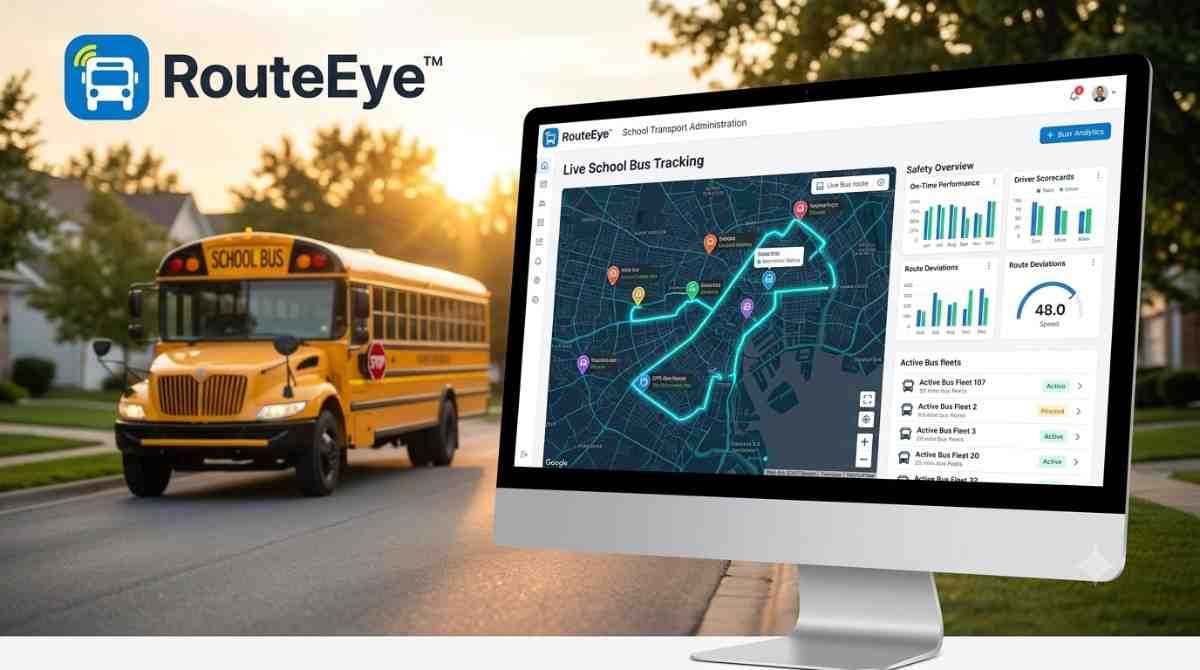
Managing a school transport network involves a continuous stream of operational challenges. For transport administrators, ensuring that dozens of vehicles arrive on time while keeping parents continuously informed can strain traditional administrative systems. Relying on paper logs, manual route planning, and reactive phone calls leaves gaps in visibility.
Implementing smart school bus tracking bridges these operational gaps, shifting student transit tracking from a reactive process to a predictive, fully controlled campus operation.
The Anatomy of Real-Time Fleet Visibility
A modern school transport system relies on continuous tracking rather than occasional location checks. Traditional GPS systems provide “breadcrumb” updates that refresh every few minutes, leaving blind spots regarding a vehicle’s precise location.
Modern tracking infrastructures use a connected ecosystem of GPS and GSM-enabled telematics. This configuration transmits live telemetry directly to a centralized web-based interface.
Copied![Vehicle Telematics Group] ---> [Secure Cloud Infrastructure] ---> [Admin Web Portal] ---> [Parent App Interface]
This structural visibility allows school transport managers to:
- Pinpoint every vehicle’s exact street location continuously.
- Monitor precise Estimated Times of Arrival (ETAs) that adjust dynamically based on live traffic conditions.
- Identify unauthorized route deviations or unexpected delays immediately, enabling teams to act before problems escalate.
Automation Beyond Coordinates: RFID Student Ridership
A vehicle tracking system only addresses half of the safety puzzle; true accountability requires tracking the student passengers as well. Integrating an automated RFID (Radio-Frequency Identification) attendance layer transforms a standard vehicle locator into a comprehensive student protection tool.
When students board or exit the vehicle, they tap a secure RFID card against an in-bus reader console.
Copied![Student RFID Card Scan] │ ▼ [In-Bus Reader Processing] ───► [Instant Cloud Validation] │ ┌────────────────────┴────────────────────┐ ▼ ▼ [Admin Dashboard Check-In] [Parent Push Notification]
This automated check-in removes the data inaccuracies of manual roll calls. If a student boards the wrong vehicle or exits at an incorrect stop, the system flags the anomaly instantly, allowing administrators to address the issue immediately.
Enhancing Safety with Proactive Driver Analytics
Vehicle hardware tracking provides valuable insights into operator behavior, helping protect students by monitoring performance behind the wheel. Specialized onboard diagnostic consoles monitor driver behavior patterns in real time, calculating a continuous driving safety score.
| Behavior Parameter Monitored | Operational Risk Mitigated | System Response Action |
|---|---|---|
| Harsh Braking & Aggressive Acceleration | Structural vehicle wear & passenger injury | Flags driver log for administrative review |
| Sharp High-Speed Cornering | Vehicle instability and loss of control | Records telemetry spike on admin dashboard |
| Sustained Vehicle Overspeeding | Kinetic collision risk & regulatory fines | Triggers immediate visual cockpit alert |
| Excessive Idling Anomalies | Fuel waste and hidden mechanical issues | Automatically logs fuel inefficiency report |
By using behavioral analytics, schools can address aggressive driving tendencies through targeted coaching before unsafe habits lead to preventable on-road incidents.
Improving Parent Communication with Real-Time Alerts
A primary source of daily administrative friction for schools is managing incoming calls from anxious parents asking about delayed buses. Smart transit systems resolve this communication bottleneck by providing transparency directly to families.
Through native application integrations or dedicated portals, parents receive automated updates tied to specific transit milestones:
- The Trip Commencement Notice: Sent when the vehicle initiates its morning or afternoon route.
- The Proximity Buffer Warning: A geofenced notification triggered when the bus enters a specific radius (e.g., 1 km) from the student’s designated stop.
- The Safe Drop-Off Check: Confirmation that the student has scanned off the bus and safely entered the campus gates.
Providing parents with direct access to real-time updates reduces the volume of inquiry calls to the front office, allowing administrative teams to focus on core operational tasks.
Streamlining School Transportation Workflows
Implementing a modern tracking infrastructure reduces administrative workloads by automating manual transportation tasks.
Advanced tracking systems simplify daily transport workflows through automated management tools:
- Algorithmic Route Optimization: Machine learning systems analyze historical traffic patterns and student location data to design short, fuel-efficient paths, reducing student commute times.
- Geofenced Boundaries: Digital perimeters mapped around specific routes track exact arrival and departure times at every stop automatically.
- Comprehensive Digital Logs: The system archives trip replays and driver behavior histories, creating detailed digital records for compliance audits, incident investigations, and maintenance scheduling.
Transitioning to automated transport management enables schools to scale their fleets efficiently, control operational costs, and maintain high safety standards across every route.
FAQ
What is RouteEye for Schools and how does it wrk?
It is a smart transit platform tracking school buses in real-time using GPS hardware, GSM telemetry, and cloud dashboards.
How does the system automatically log student attendance?
Students tap secure RFID smart cards onto an in-bus reader console during boarding and de-boarding sequences.
Do parents need to install a separate application to track buses?
No, RouteEye integrates directly into existing school apps via SDKs, eliminating the need for extra downloads.
How does RouteEye monitor driver behavior and safety protocols?
Onboard diagnostics track telemetry in real time, alerting admins to harsh breaking, overspeeding, and sudden turns.
What kind of customer support options are available for schools?
Schools get continuous 24/7 AI chatbot resolution paired with human email and phone support during office hours.

Leave a Reply