

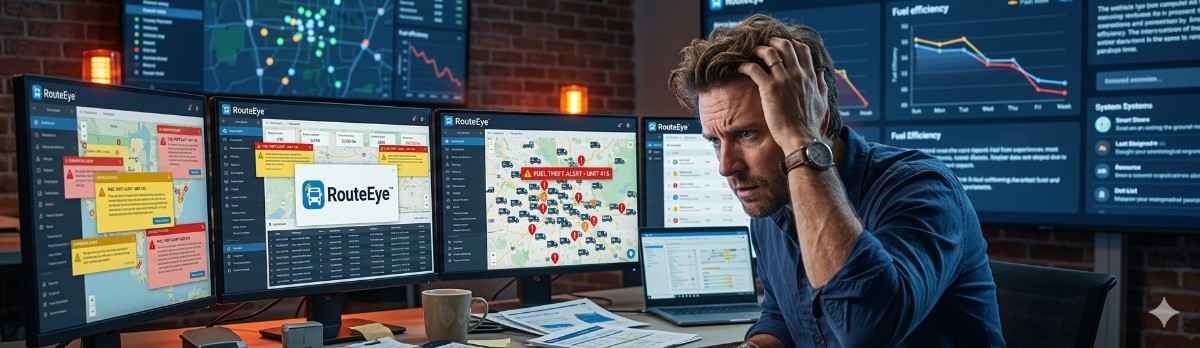
Managing a fleet has always been a balancing act, but lately, it feels like the scales are tipped entirely against you. If you are running a fleet, you are likely staring down a double-edged sword: highly volatile fuel prices and an overwhelming mountain of disconnected data.
Every fleet manager knows that fuel is one of their largest controllable expenses, typically swallowing 25% to 35% of total operational costs. Yet, despite having a dozen tracking apps, fuel cards, and GPS systems, calculating true fleet fuel efficiency remains a regular nightmare.
The truth is, many operations are drowning in raw data but starving for actual clarity. Here is why traditional vehicle analysis is failing you, the hidden drains destroying your bottom line, and how to plug the leaks.
The Core Problem: Why Traditional Vehicle Analysis Fails
Most fleet tracking problems do not stem from a lack of information. They stem from a lack of integration.
When you have to pull a location report from a basic GPS tracker, log into a separate portal to download fuel card transactions, and cross-reference both against a handwritten driver log, you are not managing a fleet you are acting as a full-time data entry clerk.
This fragmented workflow creates two massive structural vulnerabilities:
1. The Invisible Drain of Excess Idling
You cannot manage what you do not measure accurately. A vehicle engine left idling burns roughly half a gallon of fuel per hour. While a driver pulling over to take a quick call with the AC running might seem minor, multiply that across 20, 50, or 100 vehicles over a year, and you are looking at thousands of dollars literally evaporating into thin air. Without real-time telematics, identifying who is idling, where, and for how long is virtually impossible until the monthly fuel bill arrives.
2. Aggressive Driving Habits
Hard braking, rapid acceleration, and over-speeding reduce a vehicle’s travel efficiency by up to 30% on highway routes. Legacy tracking systems might tell you when a truck arrived at a destination, but they leave you completely blind to how it was driven along the way.
Copied![Fragmented Spreadsheets] + [Delayed Fuel Card Data] = Reactive Cost Control (Too Late) [Integrated Telematics] + [Real-Time Alerts] = Proactive Savings (Immediate)
The Hidden Costs of Fragmented Systems
When your tracking systems do not speak to one another, your day-to-day operations suffer from distinct operational bottlenecks:
- Delayed Decisions: Discovering a severe drop in an asset’s miles-per-gallon (MPG) three weeks after the fact means you have already paid for three weeks of wasted fuel.
- Undetected Mechanical Anomalies: A sudden spike in fuel consumption is often the first warning sign of dragging brakes, failing fuel injectors, or improper tire pressure. If you can’t easily analyze consumption trends side-by-side with vehicle health, minor maintenance issues escalate into catastrophic road breakdowns.
- Susceptibility to Fuel Slippage: Without real-time verification matching a vehicle’s precise GPS coordinates to the exact pump location during a transaction, detecting fuel card misuse or siphoning is exceptionally difficult.
How RouteEye Solves Your Fuel and Vehicle Analysis Crisis
You do not need more data points; you need automated, intelligent context. RouteEye bridges the gap between raw vehicle tracking and active fleet cost control by consolidating your entire operation into a single, cloud-based ecosystem.
Here is how RouteEye eliminates the tracking friction to keep your operations profitable:
Real-Time Anomaly Detection and Alerts
RouteEye doesn’t force you to dig through legacy monthly reports to spot waste. The platform’s built-in intelligent alert system detects behavioral and mechanical anomalies the exact second they happen.
If a vehicle is idling beyond your custom designated thresholds, running in the wrong direction, or over-speeding, an instant notification is sent directly to your dashboard or preferred messaging channel (SMS, Email, WhatsApp, or Slack). This allows you to step in and fix driver behavior immediately, rather than waiting for the end of the month.
Unified Analytics Dashboard
Say goodbye to manual spreadsheet math. RouteEye seamlessly unifies vehicle tracking, route planning, and precise distance estimation into a centralized, user-friendly interface accessible from any mobile device, laptop, or display board.
By accurately calculating Estimated Time of Arrivals (ETAs) and evaluating past trip replays, you can actively optimize your logistics, eliminate empty mileage, and ensure your vehicles are operating along the most fuel-efficient pathways possible.
Built-In Preventive Maintenance Reminders
A well-tuned vehicle is an efficient vehicle. RouteEye takes the guesswork out of asset lifecycle management by automating custom service, insurance, and license renewal reminders. Catching mechanical inefficiencies early ensures your fleet remains safe, compliant, and optimized for maximum fuel conservation.
Take Back Control of Your Fleet Operations
Relying on delayed reporting and fragmented tools is a surefire way to watch your profit margins erode. Moving to a connected, data-driven telematics platform transforms your back-office from a reactive environment into a proactive, cost-saving asset.
Stop guessing where your fuel budget is going. Turn your raw tracking data into actionable intelligence, eliminate hidden waste, and keep your drivers moving efficiently.
FAQ
1. Why is calculating fleet fuel efficiency so difficult using traditional spreadsheets?
Traditional spreadsheets rely on delayed, manual inputs from separate fuel cards and basic GPS logs. This fragmentation makes it nearly impossible to cross-reference data in real time to catch waste before it happens.
2. How much fuel does excessive vehicle idling actually waste across a fleet?
A single idling engine can waste roughly half a gallon of fuel per hour, which adds up to thousands of dollars in lost profits annually when multiplied across an entire fleet.
3. Can poor driver habits really impact my company’s bottom-line fuel costs?
Yes, aggressive driving habits like rapid acceleration and hard braking can reduce a vehicle’s highway fuel efficiency by up to 30%, quietly driving up your operational overhead.
4. How does RouteEye detect fuel anomalies or driving inefficiencies immediately?
RouteEye uses real-time telematics to trigger instant dashboard alerts the moment a vehicle exceeds idling limits or experiences a sudden drop in miles-per-gallon (MPG).
5. How does a unified tracking platform help lower vehicle maintenance expenses?
By monitoring real-time vehicle health alongside fuel consumption, RouteEye automates preventive maintenance alerts to fix minor mechanical issues before they turn into costly breakdowns.

Leave a Reply